Introduction
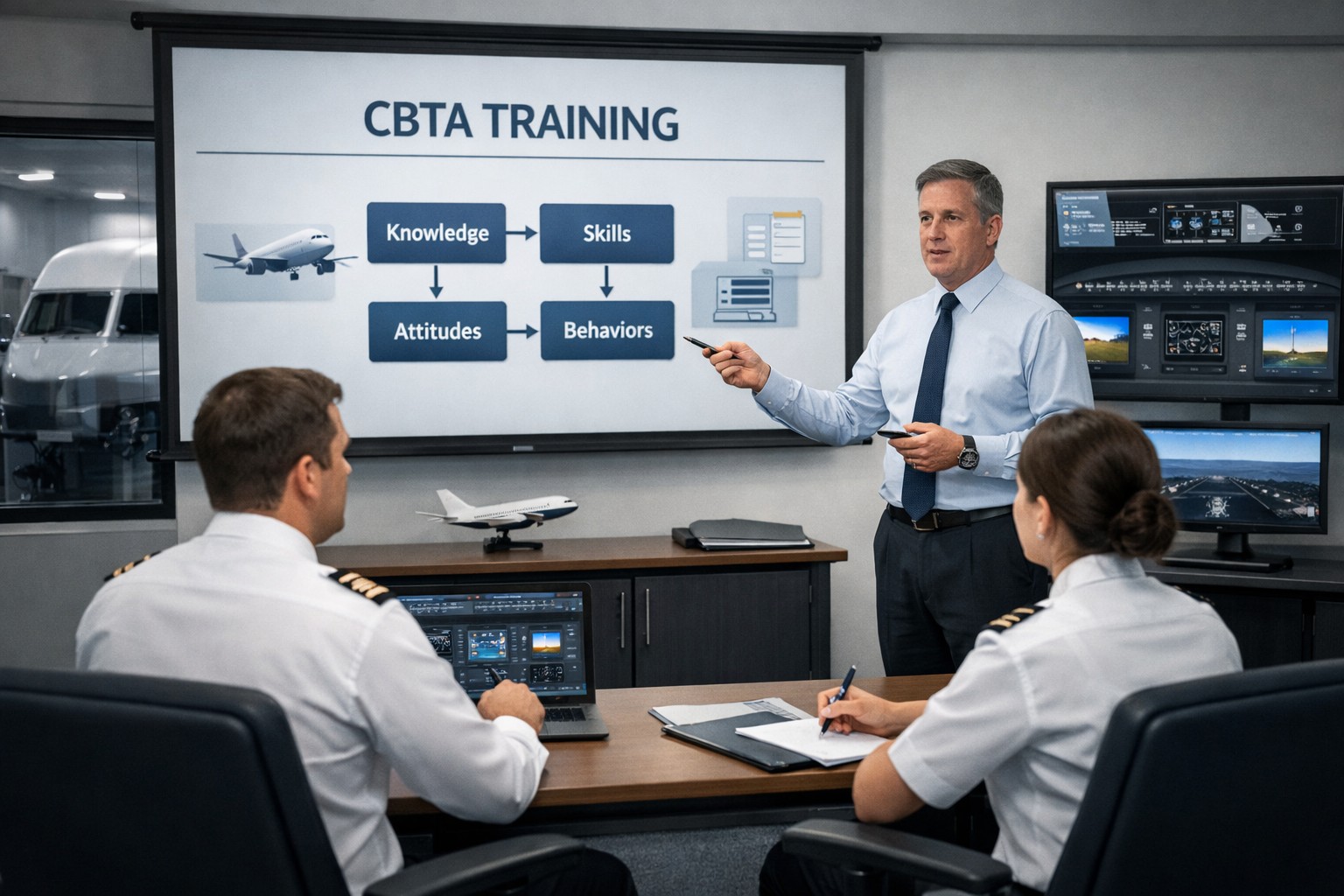
CBTA stands for Competency-Based Training and Assessment. In aviation, it is a modern training philosophy that focuses on whether a pilot, instructor, air traffic professional, maintenance technician, or other aviation professional can consistently demonstrate the competencies needed for safe and effective performance. Instead of relying mainly on fixed flight-hour requirements, repetitive task completion, or checklist-style pass/fail events, CBTA evaluates real performance through observable behaviors, practical decision-making, and measurable competence.
The approach is strongly associated with international aviation modernization efforts led by organizations such as ICAO and IATA. ICAO promotes competency-based training as a way to identify performance gaps and design training that directly addresses operational needs, while IATA describes CBTA as a more effective way to develop a competent pilot workforce than traditional task- or hour-based training alone.
What CBTA Means
At its core, CBTA asks a simple question: can the trainee perform effectively in the operational environment for which they are being trained? The answer is based on demonstrated competence, not just time spent in training. A trainee may complete a required maneuver, procedure, or simulator exercise, but CBTA looks deeper at how the person performed: whether they communicated clearly, managed workload, maintained situational awareness, applied procedures correctly, solved problems, and managed threats and errors.
This makes CBTA especially important in aviation because safety depends on more than technical skill. Modern flight operations require judgment, teamwork, adaptability, automation management, risk awareness, and the ability to respond effectively when conditions change. CBTA is designed to build and assess those capabilities in a structured way.
Key Principles of CBTA
Performance is measured through competencies. Training is organized around defined competencies such as communication, application of procedures, workload management, situational awareness, problem solving, leadership, teamwork, and flight path management.
Assessment is based on observable behavior. Instructors look for specific actions or behaviors that show whether a competency has been demonstrated.
Training is adapted to individual needs. Learners who need more practice in a particular competency can receive targeted support, while those who demonstrate competence may progress efficiently.
Operational relevance matters. Scenarios are designed to reflect realistic threats, errors, decision points, and operational conditions.
Feedback is continuous. CBTA emphasizes coaching, debriefing, evidence collection, and improvement rather than relying only on final checks.
How CBTA Differs From Traditional Aviation Training
Traditional aviation training has often been built around minimum hours, fixed exercises, required maneuvers, and standardized checks. These elements remain important, but they do not always prove that a trainee can integrate knowledge, skill, and judgment in a realistic operational setting. CBTA shifts the focus from “Did the trainee complete the task?” to “Did the trainee demonstrate the competence required to perform safely and effectively?”
For example, a pilot may fly an approach accurately, but CBTA also considers whether the pilot briefed the approach properly, monitored automation, communicated with the other crew member, managed workload, anticipated threats, followed procedures, and made sound decisions. A technically acceptable maneuver may still reveal competency gaps if the pilot’s supporting behaviors are weak.
Core Pilot Competencies Commonly Used in CBTA
Application of procedures: Correctly applying standard operating procedures, normal procedures, abnormal procedures, and emergency procedures.
Communication: Sharing information clearly, concisely, and at the right time with crew, air traffic control, cabin crew, maintenance, and other stakeholders.
Aircraft flight path management, manual: Controlling the aircraft manually with accuracy, stability, and awareness.
Aircraft flight path management, automation: Using automated systems appropriately while maintaining understanding and monitoring.
Leadership and teamwork: Coordinating with others, supporting crew resource management, and contributing to effective crew performance.
Problem solving and decision making: Identifying problems, evaluating options, managing risk, and choosing safe courses of action.
Situation awareness: Understanding the aircraft state, environment, threats, and likely future developments.
Workload management: Prioritizing tasks, managing time and resources, and avoiding overload.
Application of knowledge: Using technical, operational, regulatory, and aircraft-specific knowledge to support safe performance.
The Role of Observable Behaviors
Observable behaviors are the practical evidence used to assess competence. They are the visible or measurable actions that show how a trainee applies a competency. For example, under communication, an observable behavior might include using standard phraseology, confirming instructions, or ensuring that important information is understood by the crew. Under workload management, observable behaviors may include prioritizing critical tasks, delegating when appropriate, and avoiding fixation on a single issue.
This is what makes CBTA more objective than general impressions. Instructors and evaluators are trained to look for evidence, record it, and use it to support feedback and grading. The goal is not merely to judge a trainee, but to help the trainee understand exactly what was effective, what needs improvement, and how to improve.
CBTA, EBT, TEM, and CRM
CBTA is often discussed alongside Evidence-Based Training, Threat and Error Management, and Crew Resource Management. These concepts are related but not identical. Evidence-Based Training uses operational data to focus training on the risks and competencies most relevant to real-world operations. Threat and Error Management helps crews identify, manage, and recover from threats and errors before they reduce safety margins. Crew Resource Management focuses on communication, teamwork, leadership, decision making, and other human factors.
CBTA provides the structure that connects these ideas. It defines the competencies to be trained, the behaviors to be observed, and the assessment method used to determine whether performance is acceptable. In a mature aviation training system, CBTA, EBT, TEM, and CRM reinforce one another.
Why CBTA Matters in Aviation
Aviation is a high-reliability industry where small errors can have serious consequences. Aircraft are increasingly automated, operations are globally connected, and crews must manage complex systems, weather, traffic, procedures, company requirements, and passenger expectations. CBTA helps aviation organizations train people for this complexity by emphasizing practical competence rather than simple completion of prescribed tasks.
It also supports safety management. When organizations collect consistent training and assessment data, they can identify trends, recurring weaknesses, instructor calibration issues, and areas where training programs need improvement. This allows training to become part of a broader safety performance system.
Benefits of CBTA
Improved safety focus: Training is aligned with the competencies needed to manage real operational risks.
Better feedback: Trainees receive specific, behavior-based guidance rather than vague comments.
More efficient training: Training can be targeted to individual needs instead of applying the same amount of training to everyone regardless of performance.
Stronger instructor standardization: Instructors use common competency frameworks and assessment criteria.
Better use of data: Training organizations can analyze performance trends and continuously improve their programs.
Greater operational relevance: Scenarios can be built around realistic threats, abnormal situations, automation challenges, and crew coordination issues.
Challenges in Implementing CBTA
Although CBTA offers major advantages, it is not simply a new label for an existing syllabus. Successful implementation requires a redesign of training objectives, lesson plans, instructor training, assessment forms, debriefing methods, data collection, quality assurance, and management oversight. Organizations must ensure that instructors understand the competencies, can identify observable behaviors, and can assess trainees consistently.
Another challenge is cultural change. In some training environments, both instructors and trainees may be accustomed to hour-based progression or task-based grading. CBTA requires a shift toward coaching, evidence-based assessment, and continuous development. Without proper preparation, organizations may produce paperwork that appears competency-based while the actual training remains traditional.
Implementing CBTA in an Aviation Organization
A practical CBTA implementation normally begins with a clear competency framework. The organization defines the competencies required for the role, identifies observable behaviors, maps training events to those competencies, and develops assessment standards. Instructor training is essential because instructors must be able to observe performance, collect evidence, provide effective feedback, and apply grading standards consistently.
Training scenarios should be realistic and progressive. Early training may focus on foundational skills, while advanced training should integrate technical and non-technical competencies in more complex situations. Data from assessments should feed back into quality assurance so the program can evolve as operational risks, aircraft technology, and trainee needs change.
CBTA Beyond Pilot Training
Although CBTA is often associated with pilot training, the concept is broader. It can be applied to cabin crew, aircraft maintenance personnel, air traffic controllers, dispatchers, airport operations personnel, and aviation instructors or examiners. In each case, the competency framework must be tailored to the role. The common principle remains the same: training and assessment should prove that the person can perform competently in the operational context.
Conclusion
CBTA in aviation is a shift from measuring training mainly by time and task completion to measuring demonstrated competence. It recognizes that safe aviation performance depends on the integrated use of knowledge, technical skill, judgment, communication, teamwork, workload management, and situational awareness. When properly implemented, CBTA can improve safety, strengthen training quality, support individualized learning, and help aviation organizations prepare personnel for the complexity of real-world operations.
Interested in CBTA training at your location?
Click the picture below